In partnership with |
 |
|
WELCOME TO |
|
|
Estimated Read Time: 4 - 5 minutes |
|
|
| |
| |
Today’s Docket |
News Stories:
X Square Robot Closes ~$276M Series B at Centre of China's Embodied AI Capital Race TechStartups Ray Therapeutics Raises Series B to Advance Optogenetic Vision-Restoration Therapy Into Late-Stage Development TechStartups Startup Insight:
Startup Idea:
Social Spotlight:
Resources:
|
|
|
|
| |
|
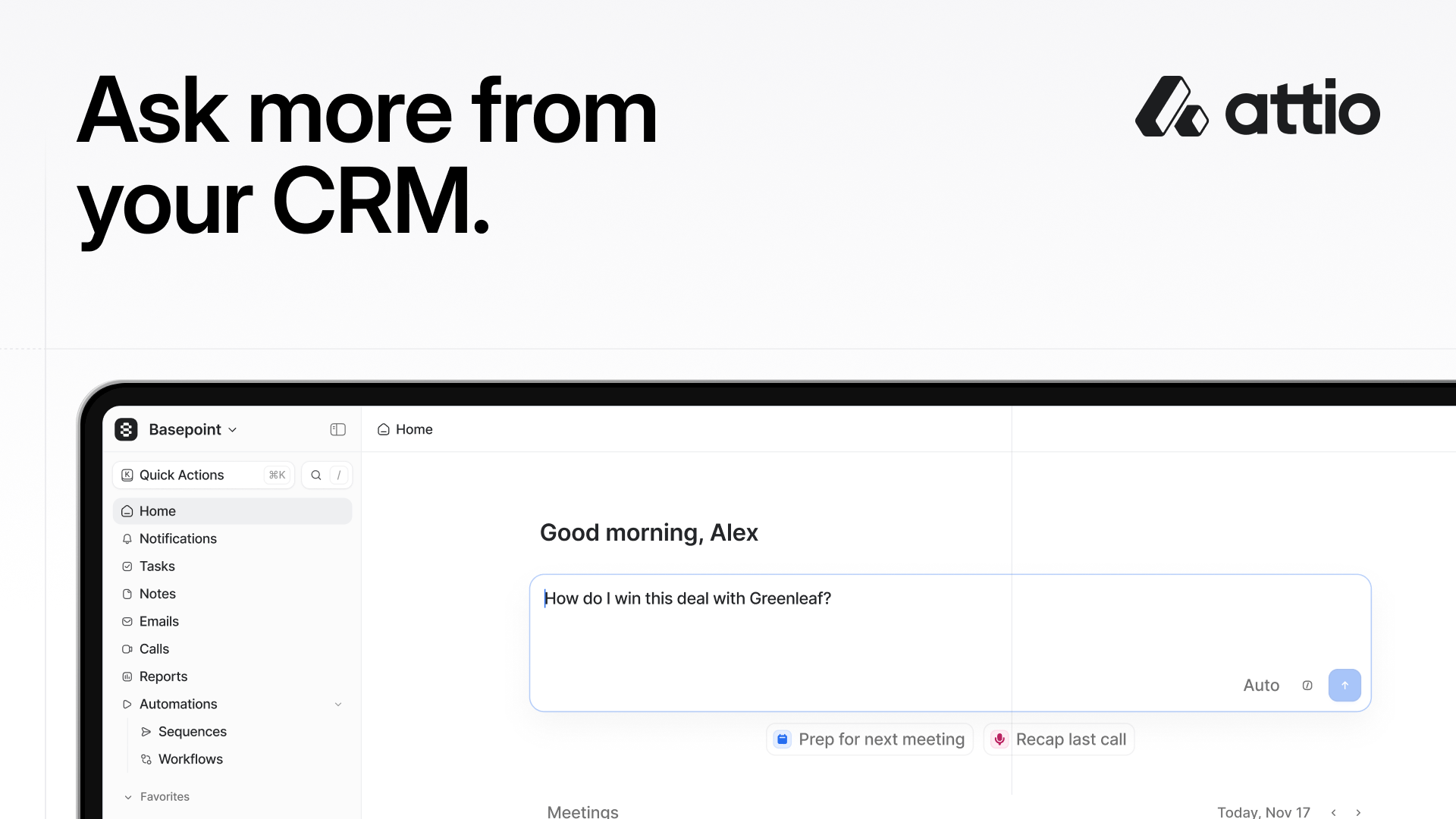
Attio is the AI CRM for high-growth teams. |
|
|
Connect your email, calls, product data and more, and Attio instantly builds your CRM with enriched data and complete context. Whether you’re running product-led growth or enterprise sales, Attio adapts to your unique GTM motion. |
Then Ask Attio to plan your next move. |
Run deep web research on prospects. Update your pipeline as you work. Find customers and draft outreach emails. Powered by Universal Context, Attio's intelligence layer, Attio searches, updates, and creates across your data to accelerate your workflow. |
Ask more from your CRM. |
Ask Attio |
| |
| |
Latest News from the World of Business |
(1) X Square Robot Closes ~$276M Series B at Centre of China's Embodied AI Capital Race X Square Robot completed a Series B of nearly RMB 2 billion — approximately $276 million — co-led by Xiaomi and Sequoia China, making it one of the most consequential embodied AI financings to surface this week. The company builds general-purpose embodied AI systems designed to link foundation models to real-world robotics deployment at industrial scale — a category that has become one of the most strategically contested parts of the broader AI stack. The round positions X Square at the centre of a concentrated capital race between China's largest technology groups to own the physical intelligence layer of the AI economy. 🔗 TechStartups (2) Ray Therapeutics Raises Series B to Advance Optogenetic Vision-Restoration Therapy Into Late-Stage Development Ray Therapeutics closed a crossover Series B to advance its lead optogenetic therapy for retinitis pigmentosa — a progressive blinding disease — into late-stage clinical development, with additional studies planned for Stargardt disease and geographic atrophy. The company has already secured RMAT designation from the FDA, a marker of clinical confidence that accelerates development timelines and signals regulatory alignment with the programme's direction. The syndicate combines crossover public-market investors with existing specialist biotech backers — a structure typically associated with companies preparing for a near-term public offering or major data readout. 🔗 TechStartups
|
|
|
|
| |
|
| |
| |
Ray Therapeutics' Series B — funding late-stage clinical advancement of a vision-restoration therapy years in the making — and X Square Robot's $276 million round building embodied AI systems at the frontier of physical intelligence share a precondition that no amount of capital can substitute for: a founding team whose culture is strong enough to hold together through the kind of long, uncertain, technically brutal work that neither company can shortcut. That is not a soft observation. It is a structural one. The companies that fail to build durable scientific or technical products almost never fail because the science was wrong or the capital ran out. They fail because the culture that the work required did not exist — or existed early and then degraded as the company scaled past the people who created it. |
Culture is among the most discussed and least precisely understood variables in company building. Most founders treat it as an output of values work — mission statements, culture decks, all-hands rituals. Those things are not culture. They are documentation of what a culture aspires to be, which may or may not correspond to what the culture actually is. The actual culture of a company is determined by a much smaller and more specific set of inputs: which behaviors get rewarded, which get tolerated, which get corrected, and which result in someone leaving. Those four outcomes, applied consistently over time, are the only things that shape what a company actually is — regardless of what the career page says about it. |
|
|
|
| |
|
It's Monday. Every department already has context. Nobody prepped anything. |
|
|
Your CFO opens Slack. There's a weekly Stripe revenue recap in #finance with a churned-accounts flag and a net-new breakdown. She didn't ask for it. |
Your head of product opens Slack. There's a GitHub summary in private channel: PRs merged, PRs stale, Linear tickets that moved. He didn't ask for it. |
Your marketing lead opens Slack. There's a Google Ads performance comparison in private channel, with a note: "Meta CPA crept up 18% this week. Might be worth pausing the broad match campaign." She didn't ask for it either. |
All-hands at 10am. Everyone already knows the numbers. The meeting is about decisions, not catch-up. |
That's what happens when one colleague works across every tool your company uses. Not one department's assistant. The whole company's coworker. |
Viktor lives in Slack. Top 5 on Product Hunt, 130 comments. SOC 2 certified. Your data never trains models. |
"Not only have we caught up on several months of work, we are automating manual tasks and expanding our operations to things previously not possible at scale." - Jesse Guarino, Director, Torque King 4x4 |
Start free. $100 in credits → |
| |
| |
Why culture is set earlier than founders expect |
The research on organizational culture is unusually consistent on one point: the dominant cultural norms of a company are established by the founding team's behavior in the first six to eighteen months, and they persist with extraordinary stability thereafter. This is not because culture cannot change — it can, but the effort required to change an established culture is an order of magnitude greater than the effort required to set one deliberately from the start. What makes early culture so sticky is that it is learned, not taught. Every new hire observes how decisions are made, how conflict is handled, how failure is responded to, and how credit is distributed — and they calibrate their own behavior accordingly. That calibration happens faster and more permanently than any explicit onboarding process can influence. |
The implication for founders is precise: the cultural norms established in the first year — not the values written down, but the actual patterns of behavior tolerated and rewarded — will still be running the company at year five, modified but not replaced by everything that comes after. A founding team that handles disagreement by avoiding it produces a company where problems get managed rather than solved. One that handles failure by assigning blame produces a company where people optimize for safety rather than for impact. One that rewards the appearance of progress rather than honest reporting of it produces a company where the board hears what it wants to hear until it doesn't. None of these patterns require a conscious decision to establish them. They establish themselves, in the absence of deliberate counterforce, from the first difficult moment the founding team faces together. |
The two failure modes most founders don't see coming |
The first is culture dilution at scale. The founding team creates a culture — often inadvertently — through the intensity of early work, the shared experience of building something from nothing, and the high-bandwidth communication that small teams achieve naturally. That culture feels cohesive and self-reinforcing when the team is ten people. At fifty, it begins to fracture. The behaviors that the founding team modelled are not being observed directly by new hires; they are being described, filtered through managers who may not have internalized them deeply, and interpreted within the norms of the previous companies those new hires came from. The founders look up one day and find that the company no longer feels like the one they built — and they are right, because the cultural transmission mechanism broke down somewhere between headcounts fifteen and forty, when nobody was paying close enough attention to it. |
The second failure mode is culture capture — when the norms of a single high-performer or tight subgroup override the intended culture of the broader team. A star engineer who ships relentlessly but treats teammates with contempt creates a local culture of fear inside their team that spreads outward faster than the founders can contain it. A sales leader who closes at any cost, including by making commitments the product cannot fulfil, creates a norm that customer honesty is negotiable. The founders know about these individuals. They often justify retaining them by reference to the output — the shipped features, the closed revenue — while the cultural cost accumulates invisibly in attrition, interpersonal damage, and the progressive departure of exactly the people who cared most about doing things the right way. The cost of that tradeoff almost always exceeds the value of the individual's output, in ways that only become legible when measured across years rather than quarters. |
What deliberate culture-building actually looks like |
It starts with behavior, not language. The most effective cultural intervention available to any founder is to make their own behavior, in difficult moments, unambiguously consistent with the culture they want to create. This sounds straightforward. It is genuinely hard, because the moments that most define culture are almost never the ones founders feel good about — they are the moments of public failure, interpersonal conflict, difficult feedback, and ethical ambiguity where the easier path is available and visible to everyone in the room. A founder who tells the truth about a bad result when the temptation to soften it is clear to the audience creates a norm for honest reporting that no culture document can replicate. One who holds a high-performer accountable for a values violation when the business case for looking away is obvious creates a norm for integrity that every subsequent hire will observe and calibrate to. |
The second mechanism is deliberate hiring for cultural contribution, not just functional competence. Every hire is a cultural vote. A person who is exceptional at their function but consistently externalizes accountability, avoids difficult conversations, or optimizes for individual recognition over team outcomes is a vote for a culture the founders did not intend to build. The founders who build strong cultures make this an explicit evaluation criterion — not by asking candidates whether they value collaboration and integrity, which produces uniformly positive answers, but by asking specifically how they have handled failure, what they have done when they disagreed with a decision made above them, and what they would do if they observed a peer behaving in a way that was effective but ethically problematic. The answers to those questions, across enough candidates, produce a team whose actual behavior in difficult moments reflects the culture deliberately chosen rather than the one that assembles by default. |
The diagnostic question worth asking now |
If you want to know what your company's culture actually is — not what you intend it to be, but what it is — ask your five most recently departed employees why they left. Not the sanitized exit interview version, but the honest version that people give to friends and former colleagues after a few months of distance. The gap between what those conversations reveal and what the company's culture documentation describes is the precise size of the cultural debt you are carrying. That debt does not service itself. It compounds, quietly and steadily, until the cost of carrying it exceeds the cost of addressing it — which is usually at a moment of stress, scale, or leadership transition when the bandwidth to address it is already scarce. The founders who close that gap early, when the team is small and the culture is still plastic, spend a fraction of the effort that the ones who close it late will spend. Most never close it at all. |
|
|
|
| |
|
|
|
| |
| |
|
Recent studies have shown that there is a growing concern among individuals regarding air quality and pollution in urban areas. People are becoming more aware of the health risks associated with poor air quality, but are often unsure of the air quality in their immediate surroundings. This lack of visibility into air quality levels can lead to increased health issues and general discomfort. A startup idea could involve developing a portable, user-friendly device that accurately measures air quality in real-time. This device could provide users with instant information about air pollutants, such as particulate matter, ozone, and nitrogen dioxide, allowing them to make informed decisions about their activities and outdoor exposure. The device could also offer personalized recommendations, such as avoiding certain areas with high pollution levels or suggesting times for outdoor activities based on air quality forecasts. |
|
|
|
| |
|
|
|
| |
| |
Was this Newsletter Helpful? |
|
|
Put Your Brand in Front of 15,000+ Entrepreneurs, Operators & Investors. |
Sponsor our newsletter and reach decision-makers who matter. Contact us at hello@stratup.ai |
Image by Freepik |
Disclaimer: The startup ideas shared in this forum are non-rigorously curated and offered for general consideration and discussion only. Individuals utilizing these concepts are encouraged to exercise independent judgment and undertake due diligence per legal and regulatory requirements. It is recommended to consult with legal, financial, and other relevant professionals before proceeding with any business ventures or decisions. |
Sponsored content in this newsletter contains investment opportunity brought to you by our partner ad network. Even though our due-diligence revealed no concerns to us to promote it, we are in no way recommending the investment opportunity to anyone. We are not responsible for any financial losses or damages that may result from the use of the information provided in this newsletter. Readers are solely responsible for their own investment decisions and any consequences that may arise from those decisions. To the fullest extent permitted by law, we shall not be liable for any direct, indirect, incidental, special, or consequential damages, including but not limited to lost profits, lost data, or other intangible losses, arising out of or in connection with the use of the information provided in this newsletter. |
|
|
|
| |
|
|





Comments
Post a Comment